



Spectacular twinkling displays are a staple of the holiday season, from elaborately lit homes to drive-through light shows. But electric lights are more than a charming way to ward off the winter gloom; they have also made this time of year considerably safer than in the past.
The first Christmas lights were candles. The practice of placing lit candles on Christmas trees dates to at least 1660 in Germany. Placing candles in windows may have originated with early American colonists. Whatever their origin, candles placed in windows and on trees became a widespread tradition. By 1856, U.S. President Franklin Pierce brought candlelit Christmas trees to the White House.
Tragically, candles often proved as deadly as they were pretty. Christmastime conflagrations occurred so regularly that, by 1908, many insurance companies refused to cover fires started by Christmas trees.
In 1911, the National Fire Protection Association, New York Board of Fire Underwriters, and Newark Fire Department issued a joint warning reading, in part, “Do not permit children to light, or re-light, the candles while parents are not present. They frequently set fire to their clothing instead. The tree itself will burn when the needles have become dry.”
Christmas candles caused fire, deaths
Old newspapers reveal horrific Christmas candle fires, including a blaze that killed 36 people in Oklahoma in 1925 and a fire that struck a Chicago hospital in 1885. In one 1905 incident, a Kansas City man dressed as Santa Claus caught fire, along with his sack of toys. (In what might be considered a Christmas miracle, he survived).
A series of innovators sought to make holiday candles safer. In 1867, a fellow named Charles Kirchhof patented a weighted candleholder meant to improve the stability of candles on trees. In 1878, Frederick Artz invented a still superior candleholder that clipped onto tree branches. But the biggest safety improvement came from switching from candles to electricity.
Three days before Christmas, in 1882, electric holiday lights were born. Just two years after Thomas Edison patented the lightbulb, one of his employees, Edward Hibberd Johnson, realized the invention’s festive potential. He wrapped some small bulbs on a wire around a Christmas tree. The Detroit Post reported on the innovation:
“There … was a large Christmas tree presenting a most picturesque and uncanny aspect. It was brilliantly lighted with many colored globes about as large as an English walnut … The result was a continuous twinkling of dancing colors, red, white, blue, white, red, blue all evening. I need not tell you that the scintillating evergreen was a pretty sight — one can hardly imagine anything prettier. The ceiling was crossed obliquely with two wires on which hung 28 more of the tiny lights; and all the lights and the fantastic tree itself with its starry fruit were kept going by the slight electric current brought from the main office on a filmy wire.”
“Electric trees will prove to be far less dangerous than the wax candle parlor trees,” Johnson noted at the time.
Electric lights were ‘extravagant’
At first, only the rich could afford such electric lights; one 1884 New York Times editorial dubbed them “extravagant.” Less than 10 percent of America had electricity when Christmas lights debuted. But the cost of electricity rapidly plummeted, and 60 percent of the country had access to electricity by the time weatherproof lights came on the market in 1927.
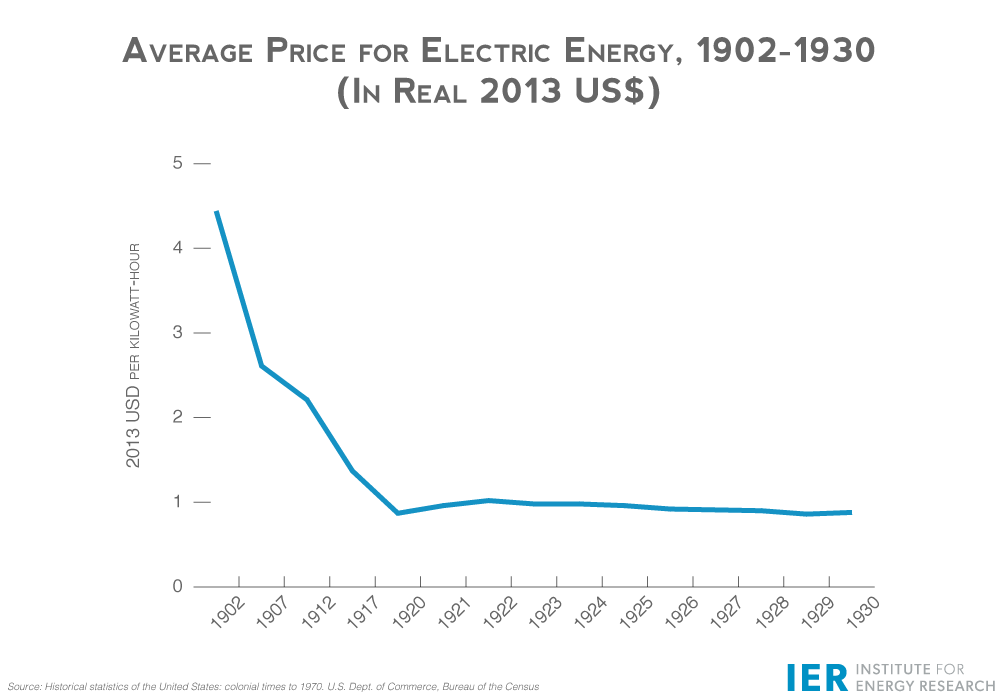
Fully lighting a Christmas tree with electric bulbs could cost as much as $300 in the early 1900s, the equivalent of around $8,500 today. The first “pre-wired” strings of electric Christmas lights, called “festoons,” launched in 1903 and cost $12 each (almost $400 today). Many people could only afford to rent rather than buy electric holiday lights.
By 1914, a string of lights cost just $1.75 (about $50 today). Business competition led to even cheaper and safer electric holiday lights sweeping the market in the 1920s and 1930s.
Electricity can also, of course, cause fires. In 1943, the singer and actor Bing Crosby, famous for holiday hits like White Christmas, lost his home to a fire owed to faulty Christmas light wiring. But thanks to continued safety improvements, house fires have been declining in frequency for decades in the United States.
So, the next time you gaze at some holiday lights, take a moment to appreciate how electricity has transformed the season and saved countless lives.
A version of this article was published by Human Progress on 12/29/2021.
And the joy and wonder of Christmas Lights, wherever and whatever they are!
Helen Keller said, "Christmas Day is the festival of optimism."
Helen was right. Reflecting on the early Christians, it's evident they possessed a profound faith and an unwavering optimism that their teachings would find resonance far and wide. Christianity has profoundly shaped cultures and societies for two millennia, bringing about significant positive changes. This legacy of faith and optimism, deeply rooted in the early Christian message, inspires and influences countless lives across generations.
Victor Perton : You said :
................And the joy and wonder of Christmas Lights, wherever and whatever they are !..........
followed by : Helen Keller said, "Christmas Day is the festival of optimism."...though she seems to be an unlikely choice to appreciate Christmas lights or Music as she was both BLIND and DEAF. Despite that , I do agree with your sentiments and observations further in your comment. Unfortunately , the spectacular commercialisation of this Religious Holiday seems to have overwhelmed the actual message , more is the pity !
I think that Christmas is the MOST family friendly time and event of the year and I look forward to it more from that point of view now !
Nevertheless , the Judeo-Christian values still firmly entrenched in our society are very much worth celebrating , Christmas lights and all !