



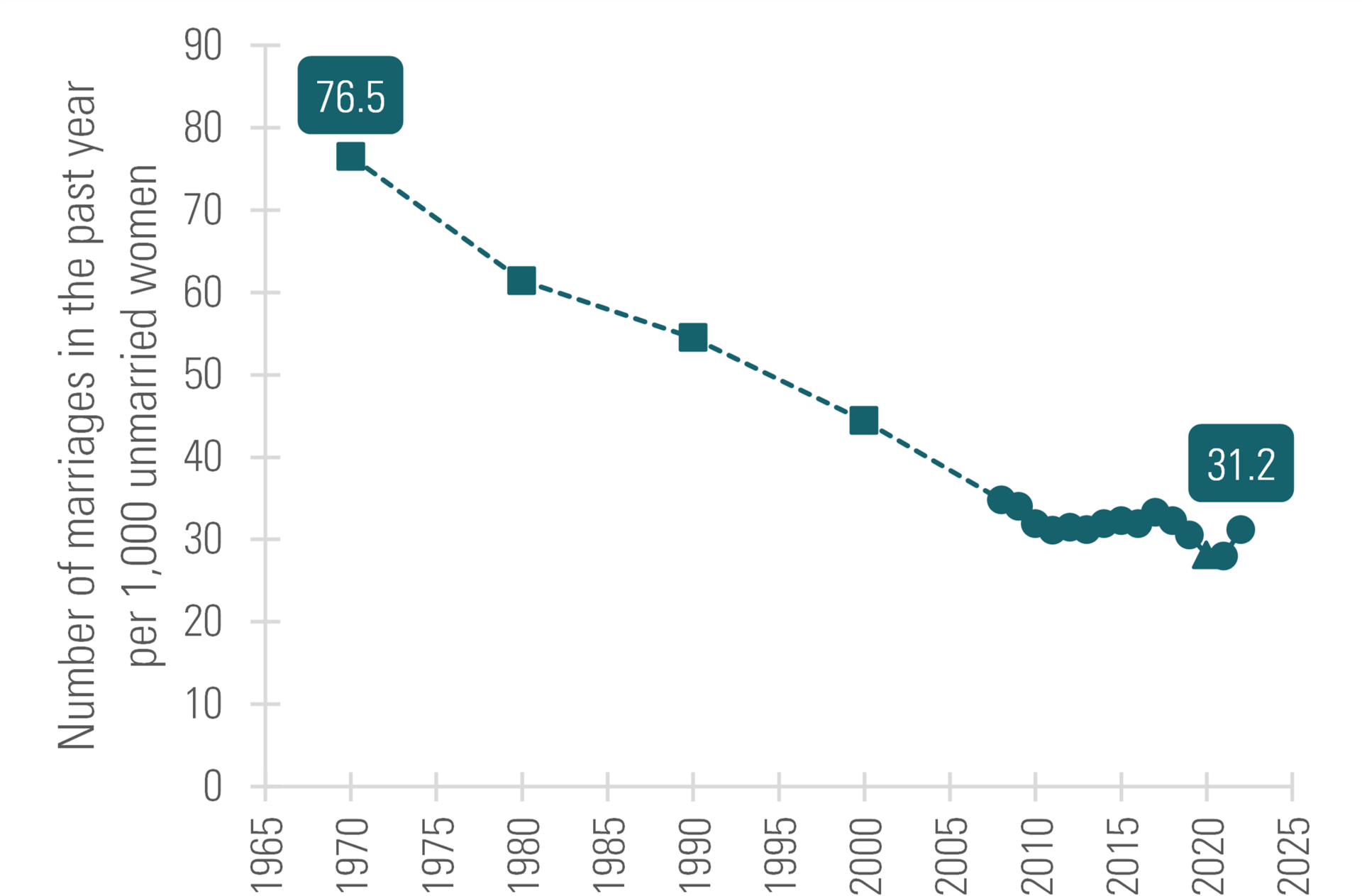
Happy Valentine’s Day! This romantic day’s namesake was a priest who was said to have performed secret marriages in defiance of a Roman emperor. Much ink has been spilled on the declining rate of marriage and which people are more or less likely to marry. Statistics showing a long-term decrease in marriage are concerning for many reasons: Fewer marriages may mean fewer people finding love, fewer children being born, and perhaps a lonelier and more fragmented society. Amid this decline in marriage it might be tempting to imagine that modern society is hopeless, while our ancestors had it made when it came to romance. Perhaps in the villages of yore, life was simpler, love and marriage came easily, and most of our ancestors lived happily ever after in contented, wedded bliss.
But the truth is that people in the preindustrial past faced few possibilities when it came to marriage. The number of potential partners in one’s tiny village was low, and the few available choices might all be one’s cousins, increasing the risk of birth defects in any resulting children. Peasants “married fellow villagers and were so insular that local dialects were often incomprehensible to men living only a few miles away,” according to the historian William Manchester. Travel was rarer, and communities were more secluded than a modern person could easily imagine. By the 18th century, little had changed: “Most villagers married people from within 10 miles of home,” as the historian Kirstin Olsen noted.
The tiny pool of possible marriage partners often produced matches that might raise eyebrows today, such as consanguineous pairings (including plenty of first cousins) and couples with huge age gaps. Even in the 18th century, in England, grooms could legally be as young as 14 and brides as young as 12, although that was rare in practice, thankfully.
Given the highly limited pool of marriage partner choices, perhaps it is unsurprising that many people seemingly settled for spouses ill-suited to them and that “much of the satirical literature of the 18th century,” in Olsen’s words, “lampooned marriage as a hell or prison sentence for one or both partners. The poem Wedlock by the Englishwoman Mehetabel “Hetty” Wright (1697–1750), herself pressured into a loveless marriage with a plumber, paints a typical picture: “Thou source of discord, pain and care, / Thou sure forerunner of despair, / Thou scorpion with a double face, / Thou lawful plague of human race, / Thou bane of freedom, ease and mirth, / Thou serpent which the angels fly, / Thou monster whom the beasts defy” . . . you get the idea.
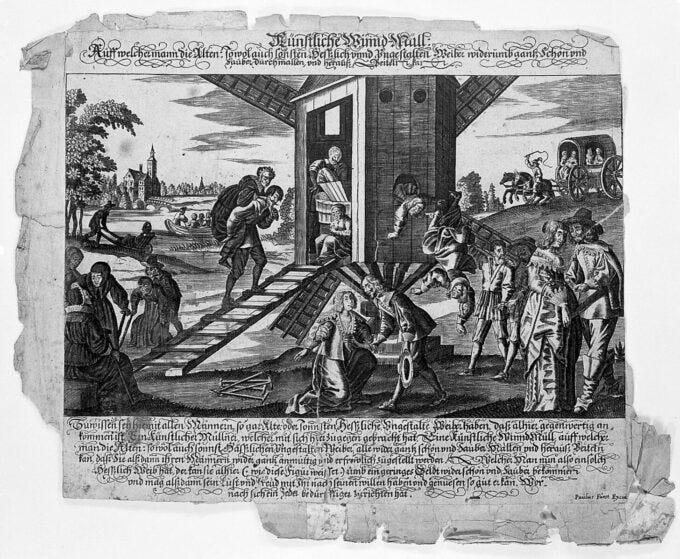
Wives like Hetty weren’t the only miserable ones. Men were also often unhappy in marriage. An illustration from the mid-1600s depicts an alleged Dutch invention to help unhappy husbands: a windmill to transform ugly wives into beautiful ones. An accompanying description claims that the mill can transform “all sorts of women, as the old, decreped, [sic] wrinkled, blear-ey’d, long-nosed, blind, lame, scolds, jealous, angry, poor, drunkerds, [sic] whores, sluts; or all others whatsoever. They shall come out of [the] mill, young, active, pleasant, handsome, wise, loving, vertuous [sic] and rich.”
Widespread antipathy towards one’s spouse also found expression in distasteful jokes such as the following from The Spirit of English Wit: to “a gentleman in the country, whose wife had the misfortune to hang herself on an apple-tree, a neighbour came in, and begged he would give him a cyon [scion] of that tree, that he might graft it upon one in his own orchard; ‘for who knows,’ said he, ‘but it may bear the same fruit?’”
Many unhappy marriages turned abusive. Courts tolerated physical abuse in most cases, and men often had the legal authority to commit their wives to insane asylums. Domestic violence was celebrated in songs such as the upbeat wife-beater’s anthem The Cooper of Fife, which I have written about previously. An abused woman’s best hope was often not legal recourse but the possibility that a male relative, neighbor, or sympathetic passerby might notice her plight and act on her behalf. Olsen notes that sometimes “neighbors intervened when men beat their wives … as a saddler did in 1703, telling the abusive husband, ‘you shall not beat your wife.’”
Women, for their part, were also known to engage in criminal cruelty toward their husbands, such as by lethally poisoning them. Sometimes these murders were committed in retaliation for domestic abuse. Aqua Tofana was a poison discovered in 17th-century Sicily that was notoriously sold through much of Italy by women to other women seeking to discreetly end their husbands’ lives. Hundreds of victims (mainly men murdered by their wives) are estimated to have perished from the colorless, odorless poison, the precise ingredients of which are today unknown. The poison has been called the “bottled revenge of the 17th-century wife.”
With so many difficulties accompanying marriage in the premodern age, it may seem a wonder that anyone married. But remaining single in the preindustrial world brought its own challenges. At the time, marriage was often the only way that women could avoid the fate of becoming unpaid live-in housekeepers to a relative. “Even before she had reached her teens, a girl knew that unless she married before she was twenty-one, society would consider her useless, fit only for the nunnery, or, in England, the spinning wheel (a ‘spinster’),” as Manchester relates.
Marriages were not only frequently unhappy but often short, ending with the untimely death of the husband or wife. In the 17th century, A History of Old Age reminds us that “disease, war, and accident all played a role in ensuring that most marriages ended with the early death of a spouse. Remarriage and blended families were much more common then, despite popular ideas to the contrary today.”
Perhaps our ancestors didn’t have it so good after all. If preindustrial marriage was, to borrow Hetty’s phrase, a “sure forerunner of despair,” today, the data suggest marriage usually makes people happy. Modern-day romance has its challenges, to be sure, but the dating pool is at least bigger than a remote village where the only options are your cousin or someone 15 years older than you. While current dysfunctional dating dynamics are worth examining, keeping a historical perspective reminds us that it could be so much worse.
A version of this article was published by Human Progress on 2/14/2025.
I just got this in the e-mail and I think that it is quite relevant ....and amusing !
Subject: Poem for those of a certain age
I remember the cheese of my childhood,
and the bread that we cut with a knife,
When the children helped with the housework,
And the men went to work, not the wife.
The cheese never needed a fridge
And the bread was so crusty and hot,
The children were seldom unhappy
And the wife was content with her lot.
I remember the milk from the bottle,
With the yummy cream on the top,
Our dinner came hot from the oven,
And not from the fridge; in the shop.
The kids were a lot more contented,
They didn't need money for kicks,
Just a game with their mates in the road,
And sometimes the Saturday flicks.
I remember the shop on the corner,
Where a pen'orth of sweets was sold
Do you think I'm a bit too nostalgic?
Or is it....I'm just getting old?
I remember the 'loo' was the lavy
And the bogey man came in the night,
It wasn't the least bit funny
Going "out back" with no light.
The interesting items we perused,
From the newspapers cut into squares,
And hung on a peg in the loo,
It took little to keep us amused.
The clothes were boiled in the copper,
With plenty of rich foamy suds,
But the ironing seemed never ending,
As Mum pressed everyone's 'duds'.
I remember the slap on my backside,
And the taste of soap if I swore
Anorexia and diets weren't heard of
And we hadn't much choice what we wore.
Do you think that bruised our ego?
Or our initiative was destroyed?
We ate what was put on the table
And I think life was better enjoyed.
But a huge fact not hereto mentioned
In this mushy tale of nostalgic rejoice,
the reason we all "enjoyed" our lot was
that we had NO BLOODY CHOICE!!!!
Yet another example of how much better the world is today than it once was !
Marriage was probably pretty rare amongst the poor in earlier periods as it was mostly a "wealth transaction" occurring between "land owners" such as Kings and Queens who managed to transfer entire countries from one regime to another.........back in "the good old days" when wives and children were a man's chattels , along with his animals , slaves , servants , land and even
whole villages were considered "his property".
Yeah ! Today we all have choices and options and wealth that were not available to our ancestors , it seems incredible that some of us even exist today given the number of obstacles that our ancestors had to navigate around or overcome ! They were a pretty tough and resilient bunch !
Even Shakespeare wrote " The Taming of the Shrew" .....and THAT was a comedy !
Nikerty nackerty noo !
During the late Renaissance, Giulia Tofana spent her younger years in apothecaries, and later she became an infamous professional poisoner in Italy. Tofana was famed for her product Aqua Tofana
which is NOW back in vogue would you believe !!?
https://www.goldbio.com/blogs/articles/an-infamous-poison-makes-a-hopeful-cure?srsltid=AfmBOoq32qFR65Q5VpERD1Qz4mSB0Z6HZ8PPrGjrOr3lXlGuS9UWgcY1
So.......perhaps all those wives were actually trying to save their husbands lives....but I doubt it !
No.....since CSI and Forensics came into being , being a husband is a lot safer today !
Yet another reason to celebrate modernity !