



Has anything changed the world more than the internet? South Korean economist Ha-Joon Chang thinks so. He would argue that one invention—an engine of liberation—has had a far more powerful effect on daily lives. He means the washing machine, of course, which the late Hans Rosling called the greatest invention of the industrial revolution. It freed women from the chore of laundry—or at least from spending one full day a week every week doing it.
As a result, Americans now lose less than two hours a week to the task, and today a greater proportion of poor US households own washing machines than average American households did back in the 1970s. While washing machines are far from being the only reason that women’s options have multiplied in the West, they have certainly helped. “Without the washing machine,” claims Chang, “the scale of change in the role of women in society and in family dynamics would not have been nearly as dramatic.”
The change is ongoing. Thanks to economic growth and rapidly declining global poverty, more women own or have access to washing machines than ever before. The International Energy Agency estimates that, in 2021, over 50 percent of households worldwide owned one. That means the market for washing machines has significant room to grow—and that there is a vast amount of latent human potential still out there, yet to be unleashed.
Take China, home to the greatest escape from poverty of all time, when economic liberalization freed hundreds of millions from penury. In 1981, less than 10 per cent of urban Chinese households had a washing machine (as approximated by the number of sets per hundred households). But by 2011, 97.05 per cent did. In 1985, less than 5 per cent of rural Chinese households had a washing machine, partly because of the expense, but also because they lacked access to electricity. By 2011, 62.57 per cent owned a machine. Thus possession of a washing machine is a useful indicator, not only of China’s tremendous progress, but of the narrowing gap between rural and urban areas.
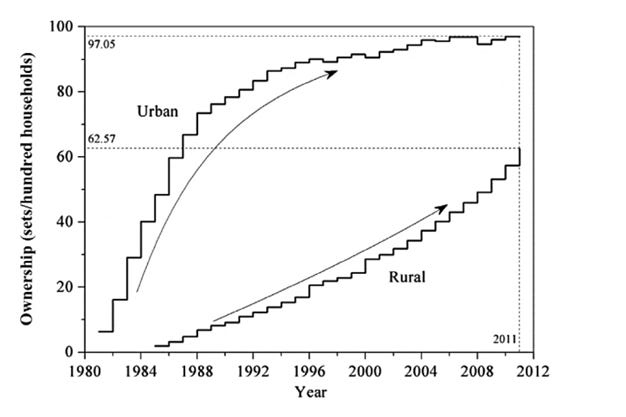
It’s a slightly different story in India, where liberalizing economic reforms didn’t begin until 1992, rather later than in China. In 2024, around 20 per cent of Indian households owned a washing machine. As with China, urban households are better off, with 40 percent owning a washing machine versus 11 percent in rural areas. That means many women still do the laundry by hand, pounding and scrubbing for hours, in some cases with no running water. Nonetheless, movement is in the right direction. As India’s economy grows and poverty declines, more women will be able to ditch the dirty washing.
We have come a long way since Bendix Home Appliances patented the first automatic washing machine for domestic use in 1937. As a Bendix ad in Life magazine put it in 1950, “washday slavery became obsolete in just 13 years” for American women. In 2007, Panasonic launched laundry machines with a sterilization mechanism designed specifically to address Chinese consumers’ priorities and successfully increased its market share in the country.
It is important to note what is at the root of this progress. Not only has competition and the profit motive incentivized the washing machine’s invention, it is the capitalist drive that is ensuring ongoing marketing to new customers in developing countries. Innovation stagnates under socialist systems, but capitalism has created more life-transforming innovations than any other economic system and sown the greatest rise in living standards in history.
Africa remains the continent with the worst record on economic freedom, as well as being the poorest continent with the least access to time-saving technologies. But even in Africa, the vicious cycle is breaking and capitalism is slowly helping to alleviate poverty. Washing machine ownership might be low, but most Africans are optimistic about their economic future and possibilities.
Thus today, washing machines are still doing the work they were doing 80 years ago – which isn’t just cleaning clothes. These juddering boxes are life-transforming technologies that allow women to put their time and labor to more constructive use. And as ownership sweeps across the world, we can also track the progress of economic freedom.
A version of this article was published by Human Progress on 4/28/2017.
Good to read "most Africans are optimistic about their economic future and possibilities"
This is a great read Chelsea ! I would argue that there are many "capitalist inventions" that have
changed , liberated and improved the lives of women..........and in keeping with that oft quoted cliche " Happy wife , happy life ! " .........much of the motivation has come FROM inventions BY men FOR the benefit of women .......and for that very reason !
Life WAS VERY HARD for everyone just a few generations ago ......now.....it's really quite a doddle !
.
Modernisation , mechanisation and electrification have released the vast majority of "Westerners" from the physical labour and anxiety that our ancestors suffered. I would rate REFRIGERATION and AIR-CONDITIONING as being "up there" with the washing machine and the reliable stove
[ now microwave as well ! ] any-day ! I must admit , many kitchen-labour-saving-devices are a pain and take longer to clean than the time they save , but generally , you can "whip up a feast" faster than you can travel to a shop and buy the Microwaveable "ready-prepared-guess-what-this-is meals" that people eat while watching TV or while being engrossed in their 'phones !
.....Distraction being a prerequisite to those meals being considered edible in many cases !!!
.
The replacement of wood with coal , gas , kerosene and finally , the harnessing of electricity changed the entire drudgery of cooking and cleaning-up afterwards..........which , in my opinion , took more time than the Monday allocated for laundry...........and I speak as the child , teenager and adult who "chopped the wood to heat the copper for the hot water to boil the laundry" ......'because soap [ even Sunlight soap ! ] wasn't nearly as good as modern washing detergents '! And the same wood also fueled the kitchen stove and the lounge-room fire and the bath-heater !
To my consternation , piped gas replaced it .......and the "WHoOOOoomp" as the gas ignited.........
scared the Hell out of me as a child and , in truth, the memory of it still scares the Hell out of me !
[ It could be argued that I owed my religious conversion to that vision of the flames in Hell !
That , and the smell of acrolein from the burnt hair and singed skin incurred when the arm with the "pilot light" was swung across to the ignite the "furnace" !!!
...............Thank God for modern electric-water-heating !!! ].
.
Getting back to the theme of "labour saving devices" i.e. the 'munificent' detergent agitator ,
there are many others , but more mundane ! Politely put ,"feminine products" of the sanitary variety MUST rate very highly , along with ready-made-clothes , clothes-driers , supermarket foods and transport of all varieties , from e-scooters , cars , buses , trains and 'planes , which have liberated us all .
No more time expended hunting for animal nutrient , weeding and planting for green-stuff !
It's all there , ready to 'harvest' in plentiful supply in shops in exchange for mere money !
Gosh ! We certainly have it GOOD !!
.
And thanks for these timely REMINDERS Chelsea !
We need to show more appreciation for the people who provided all these gadgets !
We show too little gratitude and take far too much for granted !......and still complain !!!!
[ Yeah ! Well the bloody PM shouldn't tell lies should he !! etc ]
.